
MADABE VILLAGE, Mangwe District A commu
nity development programme implemented by
the South Western Region Gender Network
(SWRGN) has brought lasting social and eco
nomic change to Madabe Village, empowering
women, youth and persons with disabilities
while strengthening community cohesion, local
leaders and beneficiaries say.
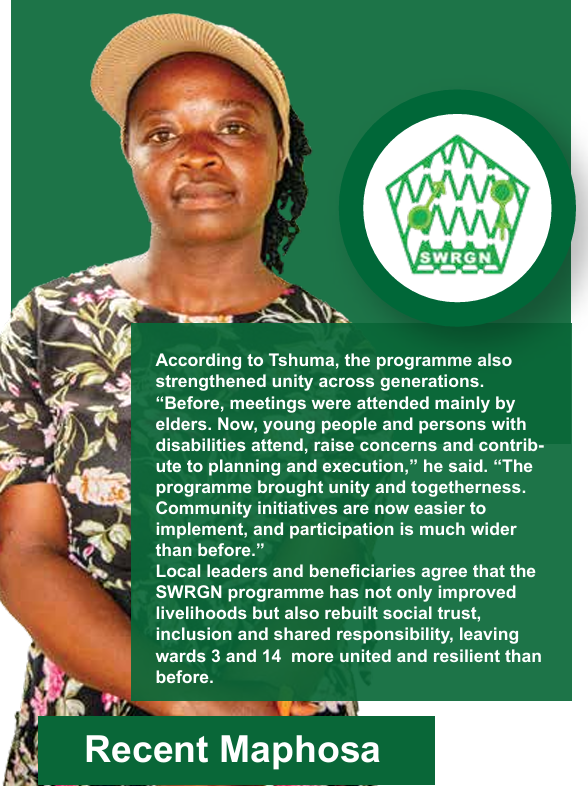
Recent Maphosa, a Community Development
Coordinator under the Ministry of Women
Affairs, Small and Medium Enterprises Develop
ment, says she first interacted with the SWRGN
project in 2019 and has since witnessed its
far-reaching impact, particularly on women’s
economic independence. She said the introduc
tion of Internal Savings and Lending Schemes
(ISALS) enabled women to form money clubs,
reducing dependence on husbands or partners
and allowing them to start small income-gener
ating businesses. “Economically, women
became stronger, and socially, cases of gen
der-based violence reduced significantly
because financial stress in households was
eased,” Maphosa said.
Maphosa added that the programme also
shaped her personal journey. Having received
training as a young participant, she later
became a gender champion, a role that
equipped her with skills that helped her secure
her current post in 2020. She cited another
beneficiary, Gugu Moyo, who now represents
child-headed families and serves in the Village
Development Committee (VIDCO), as evidence
that women are increasingly taking up leader
ship roles.
“As women, we now know that we must include
ourselves in community leadership,” she said.
The programme has also shifted youth attitudes
towards community development. Previously,
young people viewed manual community work
as the responsibility of elders or something that
required payment.
Following training and mentorship, youth now
take initiative, with Maphosa recalling how
young people led efforts during the construc
tion of a dam in Madabe, assisting builders by
carrying sand and fetching water. “Young
people are now actively participating in com
munity development,” she noted.
Persons with disabilities (PWDs), once hidden
and stigmatised, have also benefited from the
programme. Through inclusion training, com
munities were encouraged to end discrimina
tion and ensure PWDs participate in deci
sion-making spaces. As a result, PWDs formed
their own committee and ISAL group to raise
funds for small businesses, further promoting
independence and visibility.
While young people and women describe the
programme as life-changing, traditional lead
ership in the area has also witnessed a visible
shift in how the community functions.
Village head Everlast Tshuma of Ward 14 said
the programme brought “massive change” to
the community. He noted that women who
previously lacked confidence to attend meet
ings or engage in development initiatives are
now active participants, making it easier for
leaders to implement projects. Tshuma added
that youth substance abuse has declined after
young people realised that messages from
elders were reinforced by professionals
through the programme.